First Time Helicopter Flight in Rio de Janeiro: What to Expect, Step by Step

You don't need any flying experience, or even much nerve, to take a first helicopter flight in Rio de Janeiro. The first time we flew doors-off, the harness clicking shut over open air was the part that unsettled us; ten minutes in, with Christ the Redeemer filling the frame, that had gone and nobody wanted to land. What follows is the same walkthrough we would give a friend the night before: check-in and weighing, the briefing, boarding, the minutes in the air, and the landing, plus the doors-on versus doors-off decision most first-timers agonize over more than they need to. If you're still deciding between flights, the 20-minute private tour is the easiest first booking on this site.

Quick answer
No experience is needed, and you don't need to be an aviation enthusiast, just comfortable sitting still through a short safety briefing. Every passenger is weighed at check-in and seats are assigned by the crew, not chosen, and the whole visit from arrival to walking back out runs well beyond the 20 to 40 minutes you actually spend airborne.
Key takeaways
- No prior experience or flying skill is needed, the pilot and crew handle everything technical
- Every passenger is weighed at check-in, and seats are assigned by the crew for balance, not picked by you
- Total time at the helipad runs well beyond your airborne minutes, budget closer to an hour once check-in and the briefing are counted
- The number one first-timer worry is the doors-off harness; it clips to a fixed anchor point, and you can choose doors-on instead for $90 to $160 less
- The most common beginner mistake is arriving right at departure time instead of the 20 to 30 minutes early check-in wants
- Best beginner fit: the 20-minute private tour, a short, private, low-commitment first flight
Do You Need Any Experience
You need zero flying experience for any flight on this site, and you don't need to be especially fit or an aviation enthusiast either. The pilot flies the aircraft, the ground crew handles weighing and seating, and a headset does the narrating, so your only job is to show up, listen to a short briefing, and sit still for 20 to 40 minutes. If you can sit through a car ride without discomfort, you can sit through a Rio helicopter flight.
Operators provide the headset, the seatbelt and harness fitting, and full instructions on entering and exiting the cabin safely, none of which you're expected to know beforehand. There is no fitness test, since every flight here stays over land and coastline. For the full lineup of helicopter sightseeing in Rio we compare, including which flights suit a nervous first-timer best, see the comparison across the whole site.
How the Hour Runs, Step by Step
Total time at the helipad runs well beyond the 20 to 40 minutes you spend airborne. Here's the whole visit, stage by stage, and it holds whether you depart from the Heliponto da Lagoa or one of Rio's other departure points.
-
20 to 30 minutes before departure
Arrival and Check-In
You arrive at the helipad, show ID and your booking confirmation, and step on a scale. Every passenger is weighed here, not just the ones the operator suspects might be over a limit, since the crew plans seating around the real numbers for the day, not what was estimated at booking. On shared flights, this is also where you learn whether the departure is filling; most shared departures need a minimum of three passengers before the aircraft lifts off.
-
A few minutes
The Briefing
A crew member walks you through boarding and exiting safely, where to keep your hands near the rotor, how the headset and seatbelt work, and, on doors-off flights, how the harness clips to a fixed anchor point. It runs in Portuguese and English at every operator on this site; if your English isn't strong, ask in advance whether a translated summary sheet is available.
-
A few minutes
Boarding and Seating
You board in the order the crew calls, and where you sit is decided for you, for balance, not by request. The headset switches on as the rotor spins up, and liftoff comes fast after that, smooth and mostly vertical before the aircraft noses toward Corcovado.
-
20 to 40 minutes
Airborne
The flight splits roughly into the approach to Christ the Redeemer, a slow loop around the statue so both sides of the cabin get a clear view, and, on the 30 to 40-minute routes, a swing out to Sugarloaf Mountain and the beaches. The pilot narrates the whole way through the headset.
-
A few minutes
Landing and Heading Back
Touchdown mirrors takeoff, a smooth vertical set-down back at the pad. You unclip, hand back the headset, and the crew walks you out. A tip for the pilot and ground crew is appreciated but not required, and no fixed percentage is published by any operator here. Every flight is weather-dependent, with free cancellation up to 24 hours before departure if conditions or plans change.
Your First Flight at a Glance
The same walkthrough, compressed to the numbers.
| Stage | How long | What happens |
|---|---|---|
| Booking and the day before | No time commitment | Confirmation email arrives with the meeting point; nothing to prepare beyond clothing and any weight declared at booking |
| Arrival and check-in | 20 to 30 minutes before departure | ID and confirmation checked, every passenger weighed at the counter |
| The briefing | A few minutes | Safety basics, headset and seatbelt fitting, harness routine on doors-off flights |
| The flight itself | 20 to 40 minutes | Liftoff, the approach and loop around Christ the Redeemer, then Sugarloaf and the coastline on longer routes |
| Heading back | A few minutes | Vertical landing, headset returned, walked out by the crew |
Weighing In and Why You Cannot Pick Your Seat
Every passenger is weighed at check-in, full stop, no exceptions and no guessing. The number declared at booking is a planning estimate; the number on the scale that morning is what the crew actually uses to seat you and balance the aircraft. You do not choose your seat.
The crew assigns each passenger a position based on total weight and where in the cabin that weight needs to sit for the aircraft to fly level.
| Aircraft | Per-seat weight limit | Notes |
|---|---|---|
| Robinson R44 / R66 | around 130 kg per seat | Smaller cabins used on several shorter routes; declare your weight at booking so the crew can plan |
| AS350 Esquilo / EC130 B4 | No fixed published per-seat limit | Larger cabins; total load and balance decide, not one number per seat |
| Every aircraft | Weighed at check-in regardless of type | Seats assigned for balance; weight declared at booking helps planning, but the scale at the counter is what's used |
None of this is about singling anyone out. A helicopter flies on a careful balance between where the weight sits and where the rotor's lift is centered, so the crew's questions about your weight are a mechanical necessity, not a judgment call. If you're traveling with a heavier or lighter companion, expect to be seated based on the full passenger list for that flight, not who booked first.
Last verified: August 2026.
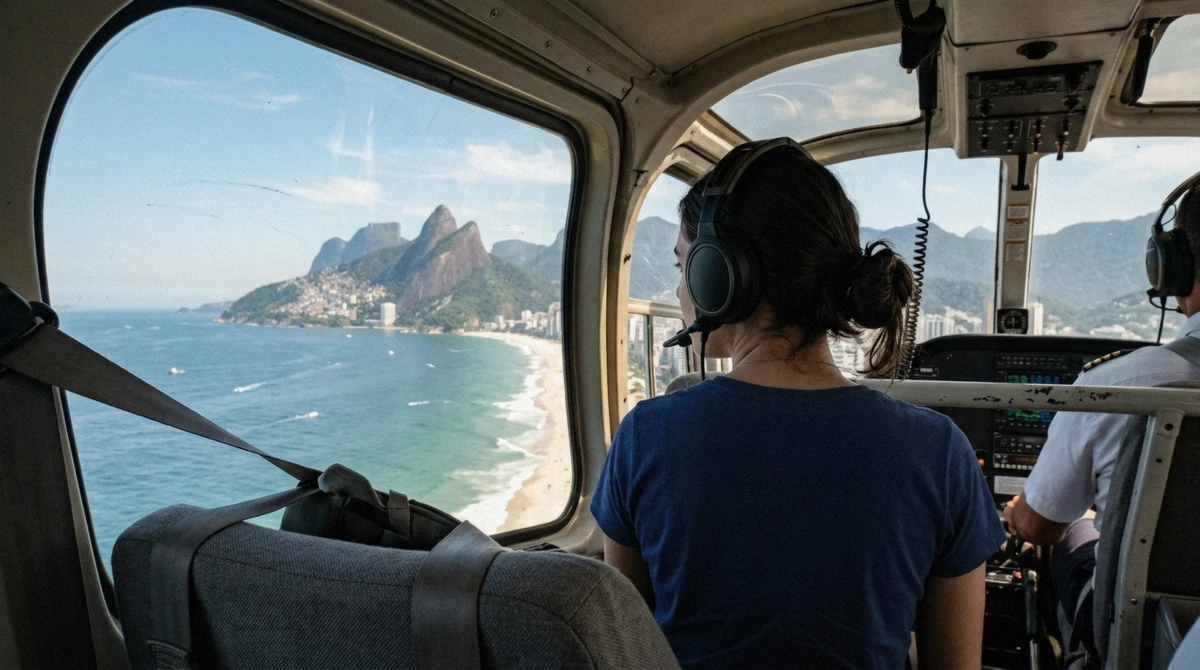
Doors On or Doors Off
This is the one real decision a first-timer makes, and both options are genuinely fine choices, not a safer option versus a riskier one.
Doors Off Versus Doors On
Doors Off
- $340 to $344 on this site's two doors-off flights
- You wear a harness clipped to a fixed anchor point
- Phones and cameras are tethered to the harness, nothing loose
- No glass, no glare, the classic shoe-selfie shot with legs over the edge
- Wind noise is real; the headset narration is your main way to hear the pilot
Doors On
- $180 to $257 across this site's doors-on flights
- Standard seatbelt, no harness needed
- Shooting through glass, which can glare or reflect in bright sun
- Quieter cabin, easier to hear the pilot's narration
- The gentler pick for a first flight if you'd rather ease into it
Verdict Choose doors-off if the photos are the actual reason you're flying and the extra $90 to $160 doesn't change your budget. Choose doors-on for your first flight if you'd rather ease into the experience, then try the open-air version another day.
What the Flight Actually Feels Like
There's no technique to learn for a scenic helicopter flight, so what actually matters is what it feels like in your body. Liftoff is the biggest sensation, a firm, mostly vertical push upward, quieter than you'd expect once the headset seals out the rotor noise. The aircraft tips forward gently as it accelerates, and the ride smooths into a steady hum, closer to a fast elevator than a rollercoaster.
Bank turns around Christ the Redeemer lean the cabin at an angle you feel in your stomach for a second, then it levels out again.
On a doors-off flight, wind is constant and cool even on a hot Rio morning, and there's a moment, right as your legs first clear the doorway, that most first-timers describe as the one flash of real nerves in the whole flight, gone within a minute once you realize the harness is doing its job. On a doors-on flight, the cabin stays calm enough that the loudest thing you'll notice is your own reaction to seeing the statue up close for the first time.
What First Timers Worry About
Five real worries, paired with what actually happens.
| Worry | The reality | What helps |
|---|---|---|
| I'll panic once the doors are off | Most first-timers describe one brief flash of nerves right as their legs clear the doorway, gone within a minute | The harness clips to a fixed anchor point before takeoff, and you can choose doors-on instead if you'd rather skip this entirely |
| I won't be able to hear the pilot | Cabin noise is real, especially doors-off | The headset seals over your ears and carries the pilot's narration clearly the whole flight |
| I'll be seated somewhere with a bad view | Seats are assigned for balance, not by request | Every seat on these flights has its own window, so the view differs, it doesn't disappear |
| I'm not fit enough for this | There's no physical exertion involved beyond sitting and buckling in | If you can sit through a car ride, you can sit through this flight |
| What if I want to stop partway through | There is no pause-and-continue option once you're airborne, since it's a short flight over open air and city, not a boat or trail you can step off of | The flight is 20 to 40 minutes total, and the crew talks you through every stage beforehand so nothing is a surprise once you're in the air |
The worry that surprises me most as a former dispatcher isn't the harness, it's the seating. First-timers assume a bad seat ruins the flight; it doesn't, since every seat on these aircraft has its own window and the pilot narrates for the whole cabin, not just one side.

Beginner Mistakes to Avoid
Six during-flight mistakes worth avoiding, none of them serious, all of them avoidable.
- Arriving right at departure time instead of the 20 to 30 minutes early check-in and weighing actually need
- Wearing loose scarves, hats, or anything that can blow off, especially on doors-off flights where loose items must be secured or left behind
- Skipping the briefing mentally because it feels routine; the harness and headset instructions are specific to that aircraft, not generic
- Expecting to pick a window seat; seats are assigned for balance, and asking to switch mid-boarding just slows down the group
- Bringing an oversized bag or camera case into the cabin instead of leaving it with the ground crew, who hold non-essential items during the flight
- Assuming the pilot will circle back if you miss a photo; the route runs on a fixed loop, so keep your camera ready throughout rather than only at the landmark you expected
What to Wear and Bring (the Short Version)
- Closed shoes that stay on your feet
- Sunglasses, and a strap if the doors are coming off
- A light layer for the breeze on the pad
- Your phone or camera with a wrist tether for doors-off flights
- Booking confirmation and the passenger weights you declared
- Nothing loose: no scarves, no wide-brimmed hats, no selfie sticks
Close-fitting clothing that won't flap or catch on the harness, secure closed-toe shoes, and sunglasses for the glare off the bay. Leave loose hats, scarves and anything not tethered to you at home if you've booked doors-off. A phone or small camera with a wrist strap works fine; anything larger goes with the ground crew during the flight, not in your lap.
Which First Flight Fits You
If You are nervous and want the shortest honest introduction
Take a 20-minute flight, long enough for the statue and the beaches, short enough that nerves never settle in
If You care most about photographs
Pay for a doors-off flight and accept the harness, the noise and the wind for glass-free frames
If You are flying with a partner and want a quiet cabin
Book a private charter so nobody else's shoulder is in your window
If You are unsure about your weight against the seat limits
Declare it accurately at booking and expect to be weighed again at check-in, so the crew can balance the aircraft
If You have one flexible morning left in Rio
Take the first slot of the day, when the air is calmest and cloud has yet to build over the ridge
Which Flights Suit a First Timer
For an easy, low-commitment introduction, the 20-minute private tour at $180 keeps the whole experience short and keeps the cabin private, so there's no unfamiliar face beside you on your first flight.
If open air doesn't worry you and the shoe-selfie photo is the whole reason you're going, the doorless helicopter shoe-selfie flight at $340 briefs first-timers thoroughly before takeoff and keeps the group small.
For first-timers who want the longer doors-off experience without feeling rushed into it, the 35-minute doors-off flight at $344 runs the fullest safety briefing of any flight on this site, useful if you want every question answered before the harness clicks shut. Whichever you pick, our worth-it breakdown covers the honest downsides of a short flight if you're still deciding whether to book at all.
Frequently Asked Questions
What happens before a helicopter flight over Rio?
Check-in 20 to 30 minutes ahead, ID and confirmation checked, a weigh-in at the counter, then a short safety briefing covering boarding, the headset and, on doors-off flights, the harness. Boarding follows right after.
Can you choose your seat on a Rio helicopter flight?
No. The crew assigns every seat based on the day's actual passenger weights, to keep the aircraft balanced. Every seat has its own window, so the view differs by seat, it doesn't disappear.
Is there a weight limit for helicopter flights in Rio?
The smaller Robinson R44 and R66 cabins carry a per-seat limit around 130 kg. The larger AS350 Esquilo and EC130 B4 aircraft don't publish one fixed per-seat number; total load and balance decide instead. Every passenger is weighed at check-in regardless of aircraft.
Should a first-timer choose doors off or doors on?
Doors-on is the gentler first flight, $180 to $257 with a standard seatbelt and glass between you and the wind. Doors-off runs $340 to $344 with a harness and open air, better suited to a second flight once you know what the experience feels like, or a first flight if photos are the priority.
Does a helicopter ride over Rio make you feel sick?
Most first-timers describe it closer to a fast elevator than a rollercoaster, with a brief stomach-drop feeling during bank turns around the statue. It passes quickly, and the flight is short enough, 20 to 40 minutes, that lingering discomfort is uncommon.
How long does a first helicopter flight in Rio actually take from arrival to walking out?
Budget close to an hour total: 20 to 30 minutes for check-in and the briefing, 20 to 40 minutes airborne, and a few minutes to disembark and walk out afterward.
Every nervous first-timer I've checked in at that counter asked some version of the same question: will I be okay. The honest answer, after watching hundreds of them walk back off the pad, is that the nerves are almost always about the unknown mechanics, not the flight itself, and once you know what's coming, there's very little left to worry about.